The year was 1918. The Civil War was over and peace had been signed with Germany. The young Soviet republic was trying to build a new economy. In June the "Decree on the Nationalisation of Enterprises in a Number of Industries, Enterprises in Railway Transport, Local Improvement and Steam Mills" was issued.
"Eh, I'll go, my fathers,
to drown my sorrows in drink.
The world is nearing its end -
nationalisation," -
wrote Vladimir Mayakovsky in the poem "Heroes and Victims of the Revolution" on behalf of a merchant displeased with the reform.
And although not everyone liked it, industrial enterprises, along with their capital and property, became the property of the Russian Socialist Federative Soviet Republic.
It would seem that the Imperial Porcelain Factory, which had always enjoyed the patronage of the royal family, could find no place in the new reality. After all, only a few years earlier the factory's figurines in the spirit of gallant festivities had been shown at the Autumn Salon in Paris, and the "Tsarskoye Selo" and "Alexandrinsky" services were being made to the order of Empress Alexandra Feodorovna...
From now on there would be no "Mir iskusstva" aesthetic and no "tsarism". The former Imperial Porcelain Factory, once the Nevskaya Porcelain Manufactory and one of the largest European porcelain manufactories, from 1918 became known as the State Porcelain Factory and passed under the control of the People's Commissariat of Education.
Instead of producing parade services and asserting the ideas of Russian statehood, the main task was now the production of propaganda porcelain. Free themes were not welcome: only propaganda and clear ideological principles, as well as technological perfection.
Amazingly, in such difficult circumstances the factory not only reoriented itself but reached unprecedented heights, thanks to the enthusiasm of the leading painters of the 1920s.
"All of Petrograd", 1923
Today genuine propaganda porcelain of those years is very rarely found on the antiques market and is sometimes more expensive than pre-revolutionary pieces. For example, the plate "Long Live Soviet Power!" (design by Z. V. Kobyletskaya) was sold at a Sotheby's auction for 28,750 pounds sterling.
Alas, the popularity and high prices of the propaganda porcelain of the State Porcelain Factory's first years are often exploited by forgers. So buying such pieces from unverified sellers and without the advice of competent experts is quite risky.
But back to history. The factory's artistic director in the 1920s, until his departure for Paris in 1927, was Sergei Vasilyevich Chekhonin (1878-1935).
Having begun his creative path as a ceramic artist, Chekhonin soon turned to the art of graphics, namely satirical caricature. The ability to express his ideas briefly and pithily later proved very useful when creating propaganda porcelain. Virtuoso command of typeface and ornament became Chekhonin's key to success. He even organised a special school of porcelain painting. His pupils and successors were A. R. Golenkina, Z. V. Kobyletskaya and B. S. Radonich.
Chekhonin's works trace the path of an experimenter: he created both strict, graphic pieces and lush floral compositions. He was a pioneer in a very difficult time and laid the foundations of the factory's style, on which the artistic achievements of the following century were built.
Today original "Chekhonin" porcelain is rarely found and, as mentioned earlier, sometimes costs colossal sums. That is why the modern Imperial Porcelain Factory has released a limited number of high-quality replicas, which are a more affordable and quality alternative.
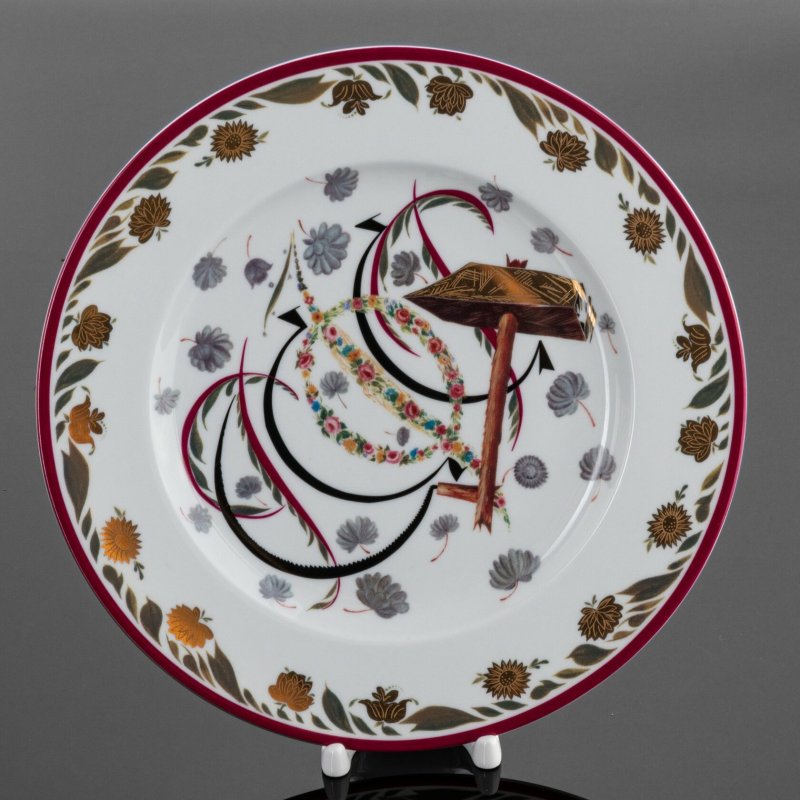
Wall plate "RSFSR" (replica of S. V. Chekhonin's 1922 work from the collection of the State Hermitage) in a gift box (limited edition), No. 36 of 200, 2006. From the collection of the Odnajdy gallery.
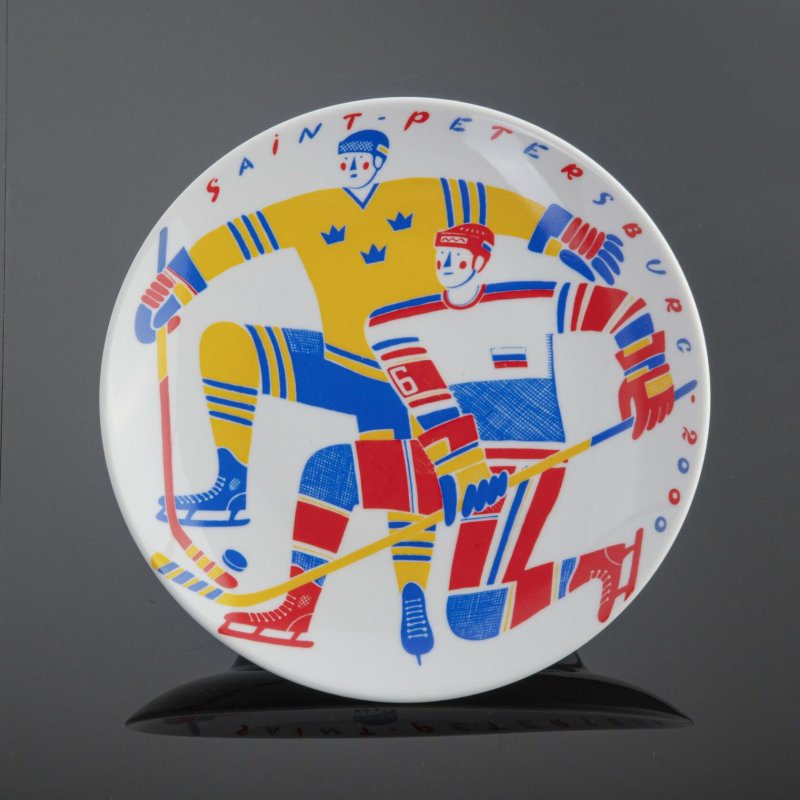
Wall plate "World Ice Hockey Championship", porcelain, decal, Leningrad Porcelain Factory (Lomonosov Porcelain Factory), Russia, 2000. From the collection of the Odnajdy gallery.
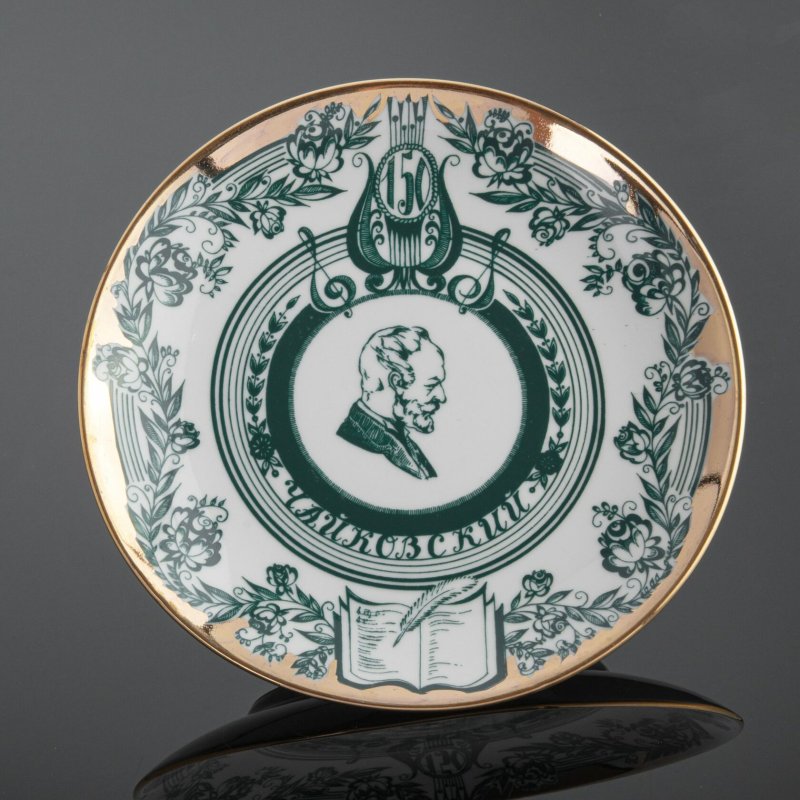
Decorative plate "For the 150th Anniversary of the Birth of P. I. Tchaikovsky", porcelain, decal, gilding, Leningrad Porcelain Factory (Lomonosov Porcelain Factory), USSR, 1990. From the collection of the Odnajdy gallery.
Today propaganda porcelain pieces are recognised masterpieces. But in those years the artists of the State Porcelain Factory travelled a very hard road, trying to find a balance between form and content. It was a period of creative searching and doubt. Some early works are somewhat difficult to perceive: lush floral motifs do not always sit well with the harsh message of the slogans. In the 1920s, however, form and ideological content were successfully harmonised.
The propaganda porcelain was worked on by A. V. Shchekotikhina-Pototskaya, N. Ya. Danko (including in collaboration with her sister E. Ya. Danko), V. V. Kuznetsov and other masters. Famous painters were also invited to contribute: B. M. Kustodiev, K. S. Petrov-Vodkin, K. S. Malevich, N. M. Suetin. Porcelain became a true conductor of revolutionary sentiment, and indeed its pure, clear structure was perfectly suited to materialising the ideas of the avant-garde.
Natalya Yakovlevna Danko (1892-1942) is one of the key figures in the factory's history. A native of Tiflis, from 1908 she lived and studied in St Petersburg, and in 1914 she was hired as a sculptor at the Imperial Porcelain Factory. In 1919 she was appointed head of the sculpture department. She was also responsible for sculpture production for export. Her sister Elena, an artist and poetess, worked alongside her.
Sculptor Natalya Yakovlevna Danko. Federal State Budgetary Cultural Institution "State Central Theatre Museum named after A. A. Bakhrushin"
Danko answered the ideas of the young Soviet power better than anyone: the "Reds and Whites" chess set, the figurines "Fifth Anniversary of the Red Army", "Embroidering the Banner", "Sailor with a Banner", "Woman Militiaman" and others. More neutral themes attracted her too: for example, in her works she depicted various figures of the arts: Pushkin, Nijinsky, Akhmatova, Meyerhold...
Perhaps her most famous work is the decorative mug "Milk" in the shape of a woman's head, later painted by the artist A. V. Vorobyevsky. These later-issue mugs (1950s-1960s) in red and white survive in many Leningrad families.
It is remarkable that the origins of this highly original artistic solution came to pre-revolutionary Russia from England, where jugs in the shape of human figures (tobies) were popular. Danko added the languid character of the East to the traditional European form, and the result was the "Milk" mug. By the way, a very rare mug painted by Elena Danko is now kept in the museum of the Imperial Porcelain Factory.
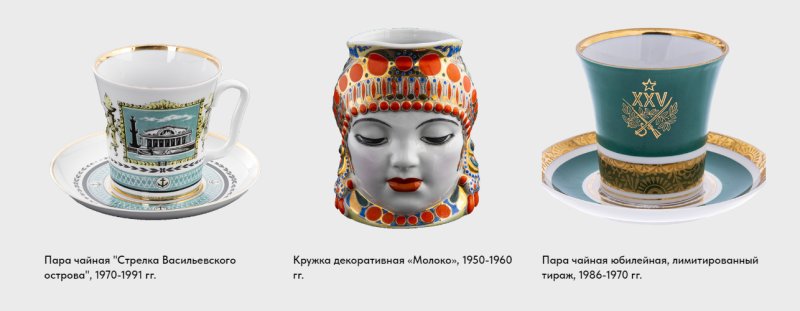
Thus, in the painting of the State Porcelain Factory's propaganda porcelain the most interesting and distinctive solutions belong to S. V. Chekhonin, while in the field of porcelain sculpture, also oriented towards propaganda, the most significant mark was left by the works of N. Ya. Danko. Her characters are the brightest illustrations of human types of the 1920s and, in particular, of the NEP period, and it is clear that the sculptor took the very best from the tradition of Russian artistic plastic art of the early 20th century. That is why her works are not only historically authentic but also extraordinarily engaging.
Sculptural group "Trusikha"
Besides artistic work, technical research was also carried out at the factory in the early Soviet years. In 1923 an optical glass-blowing shop was set up. The factory also produced technical and chemical porcelain, which expanded the possibilities for artists. In 1924 it was renamed the Leningrad Porcelain Factory, at the same time as Petrograd was renamed Leningrad. In recognition of the factory's high achievements, in 1925, when the Russian Academy of Sciences celebrated its 200th anniversary, the factory was given the name of M. V. Lomonosov. In the future it was the Lomonosov Porcelain Factory that mastered the technology of bone china production.
Meanwhile the 1930s arrived.
Socialist realism was established in the visual arts. Interest in monumental forms revived. Ideological content, generalisation and concreteness of images replaced the searching of the numerous artistic associations of the early Soviet years. Porcelain art, perhaps, remained freer than painting, not counting, of course, the state orders that had to be fulfilled.
The pre-war years became a period of flourishing for the Leningrad Porcelain Factory. In the 1930s, at the peak of ideological propaganda, the country's first art laboratory was opened at the factory. Under the leadership of Nikolai Mikhailovich Suetin, chief artist from 1932 to 1954, who set a very high bar for the work, the style of the pieces created became maximally consonant with the ideas of socialism, the forms acquired completeness and laconicism, while bright, saturated colours were used. Realistic motifs were woven in as well. During this period the factory also actively fulfilled various state orders.
One of the leading artists of the pre-war years was Ivan Ivanovich Riznich (1908-1999). In 1926 he graduated from the art school in Pavlovsk, and already in 1927 he began his creative path as a sculptor and painting artist at the Leningrad Porcelain Factory, where he worked, apart from a short break for evacuation, until 1956. Many of his works became models for serial production. Animals, flora and hunting were his favourite themes. His small-scale sculpture is distinguished by expressive form and a natural painting palette. Later on he also painted the famous series of figurines "Gogol Characters" (sculptor B. Ya. Vorobyov). Agitational themes attracted him to a lesser degree, although he did produce works on the theme of the exploration of the North, collective farms and the figure of V. I. Lenin.
One of his most famous works is the figurine "Papanin's Laika", depicting a dog named Vesyoly who took an active part in the famous polar expedition led by Ivan Dmitrievich Papanin on a drifting ice floe. The dog faithfully guarded the station from bears to the very end of the expedition and then safely returned to land, and Papanin wrote an article about his faithful friend, glorifying the "fifth Papaninite" throughout the Soviet Union. That is why this figurine became hugely popular across the country and was issued in various painting variants.
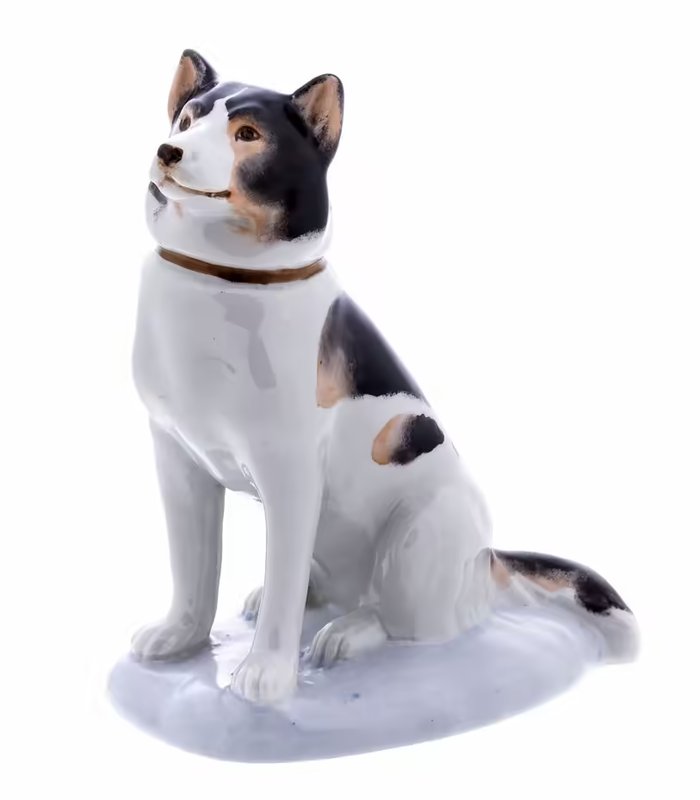
Figurine "Papanin's Laika", porcelain, painting, Leningrad Porcelain Factory ("LFZ"), sculptor I. I. Riznich, USSR, 1940s-1950s. From the collection of the Odnajdy gallery.
Another key figure in the factory's pre-war history was Alexey Viktorovich Vorobyevsky (1906-1992). Having also graduated from the art college in Pavlovsk near Leningrad in 1926, he joined the factory. His teachers were I. G. Mikhailov and S. V. Chekhonin. Vorobyevsky's works clearly show a fascination with the theme of theatre, as well as with folk art, fairy tales and fantastic subjects. After just a year of work his vases were awarded a diploma at an international exhibition in Milan. He gravitated toward the decorative and, like some other artists, touched on agitational themes only on the occasion of important commissions. In 1969 Vorobyevsky was awarded the title of Honoured Artist of the RSFSR. But his most famous works belong to the later, post-war period, so we will mention them further on.
Thus the pre-war beginnings of A. V. Vorobyevsky, I. I. Riznich, M. N. Mokh, T. N. Bezpаlova-Mikhaleva, L. V. Protopopova, L. K. Blak, A. A. Yatskevich, S. E. Yakovleva and other most talented sculptors and artists determined for many years to come the look and artistic line of development of the Leningrad Porcelain Factory with its precision and purity of form, clarity of imagery, harmony of colour combined with impeccable porcelain quality.
"Friends, we have taken her up,
we carry your relay baton.
With her we walked through the days of winter.
In the suffocating gloom of her suffering
we lived with all the strength of our hearts,
with all the light of our creative daring"
O. F. Berggolts
The war years were a heavy trial for the Leningrad Porcelain Factory. Many artists went to the front, and A. V. Vorobyevsky was even taken prisoner. The factory and the museum collections were evacuated to the Urals. The artists who remained in besieged Leningrad thus lost their work. However, despite the harshest conditions, the art laboratory resumed work from 1943.
The Leningrad Porcelain Factory team suffered great losses. In late February 1942 N. Ya. Danko's family was evacuated from besieged Leningrad to Irbit. Alas, Natalya's mother and sister died on the way, and she herself died of exhaustion almost immediately after arrival. The spouses N. A. Koltsov and T. S. Kuchkina also did not survive the siege. It was the latter, by the way, who began developing the theme of childhood and motherhood in the porcelain sculpture of the Leningrad Porcelain Factory.
The young artist Anna Adamovna Yatskevich (1904-1952) also remained in besieged Leningrad, a native Leningrader who refused the chance to evacuate. Her sister and mother died in the besieged city. The artist herself spent this period camouflaging ships.
As is well known, it was the siege of Leningrad that inspired the artist to create the legendary "Cobalt Net" design. Windows taped up crisscross and the beams of searchlights formed the basis of the delicate geometric pattern. At first the artist applied the pattern with a cobalt pencil, but in the end it was decided to use a brush.
A. A. Yatskevich at work
In March 1946 Anna Adamovna was awarded the medal "For Valiant Labour in the Great Patriotic War". She also had the medal "For the Defence of Leningrad". Unfortunately, the siege undermined her health, and the artist died quite early.
In 1958 at the International Exhibition in Brussels the artist was awarded a gold medal (posthumously), and the service itself gained unprecedented popularity among Soviet citizens and became the calling card of the Leningrad Porcelain Factory. At the exhibition it was presented in the famous "Tulip" form by S. E. Yakovleva, although today it is also produced in other forms. Soon the pattern was also awarded the "USSR Quality Mark", which was extremely prestigious.
To this day this service is the best-selling of all the factory's products; it is often given as a holiday gift, as are individual tea or coffee pairs. But it is the early issues with the blue "LFZ" factory mark on the bottom that collectors covet most.
In the difficult post-war years the works of the Leningrad Porcelain Factory naturally became more cheerful, glorifying peace and giving hope for a bright future.
In 1946 a huge "Victory" vase 2.5 metres high with a portrait of I. V. Stalin was made at the Leningrad Porcelain Factory. Today the vase is kept in the museum on Poklonnaya Hill. For this work the factory team received a telegram of gratitude from the head of the USSR.
In 1949 another order was received for a parade vase, "Builders of Communism". The fairly simple jar-like shape of both vases with a low neck gave the artists a wide space for painting. Soviet symbolism in the form of ribbons, banners and ears of wheat was executed in red and gold, and portraits of Lenin and Stalin were placed in the shields.
"Builders of Communism" vase
In the vases, of course, the ideological canon of depicting the General Secretary is evident, but they are also distinguished by decorativeness, originality and the highest artistic level of execution.
Nikolai Mikhailovich Suetin (1897-1954), who headed the creative team in this difficult time, according to the recollections of contemporaries, personally spoke with each artist during his rounds, taking an interest in all works and ideas. We already know his name from the factory's pre-war history: he began his work at the State Porcelain Factory as early as 1922, and in 1932 he was appointed chief artist. He held this post until his death in 1954. In the early years he created mainly suprematist porcelain and had a significant influence on young artists. In the post-war period the forms he presented became softer, but he undoubtedly remained one of the main followers of K. S. Malevich.
Cup and saucer from the "Scarlet Flower" service, form by Suetin N. M., painting by Vorobyevsky A. V., 1948
On the whole, the 1940s-1950s were distinguished by a strict routine at the factory, but this was dictated by the realities of the time. According to the plan, artists were required to turn in one service or two items a month, and sculptors one sculpture a month. As a result, by 1954 output had grown 3.5 times compared with 1950. The Party dictated the creation of models for mass consumption and the expansion of the product range.
The factory received important state orders. In 1960 the Council of Ministers of the USSR ordered a service for 2,000 persons for the Kremlin. More than 70,000 items were produced for the service in total ("Youth" form, design by Yu. V. Okhotina).
However, the main achievements of the Leningrad Porcelain Factory certainly lay not in the fulfilment of state orders.
The "Khrushchev Thaw" that began in the 1950s brought new artistic ideas and creative freedom, as well as participation in domestic and world exhibitions. The primary challenge facing sculptors and artists was the integration of art into the life of the Soviet person. In this period the opulence of Stalinist art gave way to simplicity and laconicism of form.
Mikhail Nikolaevich Mokh (1911-1978) was appointed chief artist in 1954. He received his art education at the school in Pavlovsk near Leningrad and in 1929 joined the Leningrad Porcelain Factory, but later left it for a while and worked as a restorer at the State Hermitage. Mokh's works show a fascination with the theme of the East, in particular the miniature. In 1958 at the World Exhibition in Brussels he was awarded a silver medal for painting the "Does" service.
The 1958 Brussels World Exhibition, which we have mentioned twice, became a landmark for the factory, which sent more than 200 exhibits. A total of 45 countries took part in the exhibition. The success was colossal. The Grand Prix and a gold medal were awarded to V. L. Semyonov for the vases "Crystal" and "Marine"; gold medals were also received by S. E. Yakovleva, E. M. Krimmer, A. V. Vorobyevsky and A. A. Yatskevich (posthumously). Silver medals went to B. Ya. Vorobyov, I. S. Efimov and N. M. Mokh, and a bronze medal to L. I. Grigoryeva.
A. V. Vorobyevsky, whose name was already mentioned in the context of the factory's pre-war history, created his most recognisable works in the 1950s-1960s, distinguished by decorativeness, brightness and a characteristic style.
In particular, a few years ago a pair of vases with the artist's hand painting was sold at a Sotheby's auction for 10,000 pounds sterling. But fortunately, his works were actively reproduced owing to their popularity, so pieces based on Vorobyevsky's designs can be found at more affordable prices (tea pairs, plates, small samovars, decanters, etc.).
Another Leningrad Porcelain Factory artist whose vases are recognisable and beloved by collectors is Vladimir Mikhailovich Gorodetsky (1924-1977). Gorodetsky worked at the factory from 1947, and his works were successfully shown at exhibitions abroad. They are distinguished by decorativeness, a gravitation towards plant and animal motifs, and are most often executed in a blue-green palette.
The 1950s-1960s were the heyday of small-scale porcelain sculpture, which became part of everyday Soviet culture and successfully fitted into daily life, even the most modest. After the war the country suffered a shortage of kind, bright emotions. That is why intimacy, accessibility and expressive imagery, as well as mass production, are the key characteristics of the figurines of this period. Artists turned to themes of childhood, motherhood and youth; particular attention was also paid to the plastic arts (ballet) and images of writers. Animal sculpture flourished as never before.
Let us note a few names of leading sculptors of that time, although it is quite difficult to single anyone out personally, since all the works of the Soviet period are executed very talentedly and it is hardly possible to list all the names within a brief historical overview.
From 1955 the sculptor Efim Aronovich Gendelman (1914-1982) worked at the factory; by that time he had enormous experience in both small-scale sculpture and monumental projects. His best-known figurines are "On the Beach", "Figure Skater-Sportswoman", "The Winner", "Bather", "Pushkin the Lyceum Student", "At the Etude", "Summer Day" and others. At the All-Union Art Exhibition of Folk and Decorative Art of the RSFSR in 1958 he received a second-class diploma for the works "At the Etude" and "On the Beach".
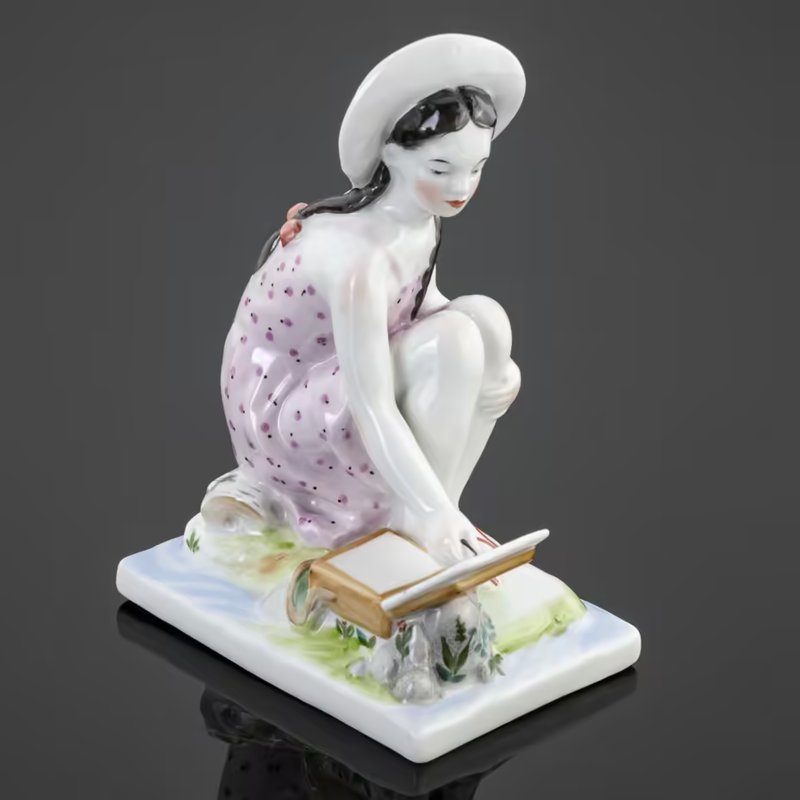
Figurine "At the Etude" (top grade), sculptor Gendelman E. A., porcelain, overglaze painting. From the collection of the Odnajdy gallery.
Galina Sergeevna Stolbova (1908-1996), a native of Kirov, began her art education with two years of study at the studio of the Association of Artists of Revolutionary Russia. In 1937 as a sculptor-artist Stolbova began collaborating with Lenizo (the cooperative association of Leningrad artists engaged in decorative and applied art, design, painting and graphics). From 1949 to 1964 she worked at the Leningrad Porcelain Factory. Her best-known series is "Happy Childhood", endearing for its touching, sincere images of children.
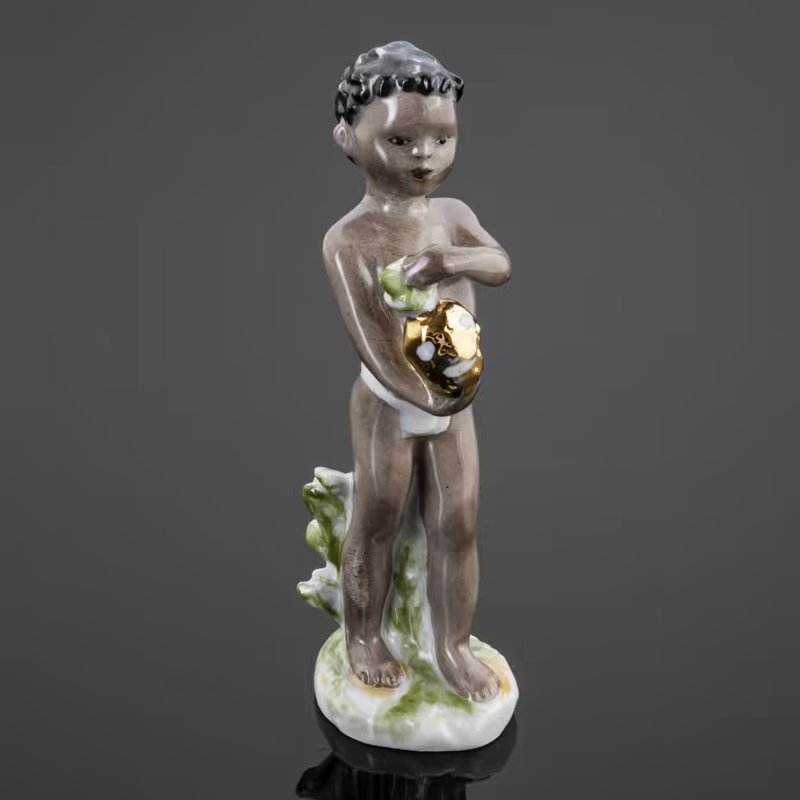
Figurine "Black Boy with a Pineapple", sculptor Stolbova G. S., artist Lupanova E. N., porcelain, painting, gilding. From the collection of the Odnajdy gallery.
She also worked on the theme of motherhood. Her famous figurine "Ladushki" (Pat-a-Cake) depicts a woman with a baby on her knees. Despite the simplicity of the composition and the laconicism of the forms, the figurine is full of tenderness, purity and truthfulness, and the image of the young mother reflects the culture of those years.
In 1964 Pavel Pavlovich Veselov (1926-1994) came to the factory. In 1953 he graduated from the faculty of decorative and monumental sculpture of the Leningrad Higher Art and Industrial College; at the same time he chose animal sculpture as his theme and began working with ceramics. While working at the Leningrad Porcelain Factory he successfully took part in domestic and international exhibitions, and at the ceramics exhibition in Ostend in 1959 he received a silver medal for the ensemble of five sculptures "Giraffes". Animal figures based on his models are still reproduced today. All his works are distinguished by realism and lightness, as well as by the absence of pedestals, which allows them to fit into any interior.
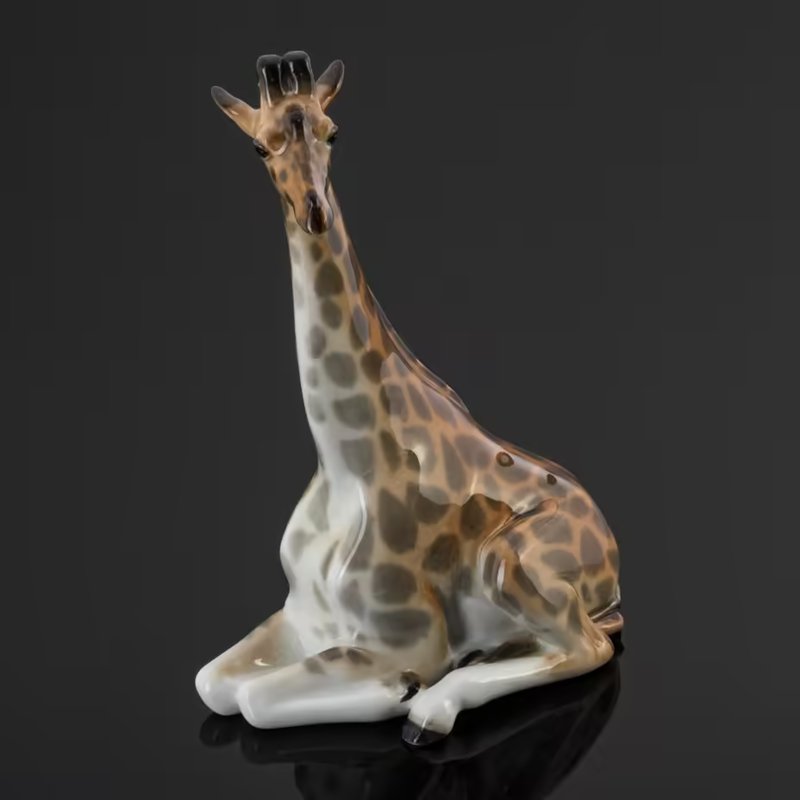
Figurine "Giraffe", sculptor P. P. Veselov, porcelain, airbrush painting, painting. From the collection of the Odnajdy gallery.
Boris Yakovlevich Vorobyov (1911-1990) also became famous primarily in the genre of animal sculpture, but his images of animals are distinguished by a different, more serious character. Vorobyov was a very versatile man, but he was drawn above all to nature and art. For some time he worked in a circus, which gave him material for his future work as an animal sculptor.
The sculptor received his higher art education at the All-Russian Academy of Arts in Leningrad. Contrary to tradition, for his diploma work he chose not the depiction of a human being but sculpted a she-wolf in a trap, which caused a real sensation in those years. From then on, animal sculpture was no longer considered a "low" genre. Still a student, Vorobyov began moonlighting at the Leningrad Porcelain Factory, where he remained until 1972. In depicting animals he conveyed in plastic form their dignity, expressiveness and inner strength. For creating the figurine "Panther" the sculptor was awarded the Grand Silver Medal at the World Exhibition of Arts and Industry in Brussels in 1958.
"Black Panther". Model and painting by B. Ya. Vorobyov, 1956
He also created the famous series of figurines based on I. A. Krylov's fable "Quartet".
Despite his love of animal sculpture, Vorobyov also produced true masterpieces of small-scale sculpture depicting people, for example the Gogol characters (series based on "Dead Souls" and "The Government Inspector", as well as "The Slippers", "Vakula on the Devil" and others).
Among the animal sculptors, Nikolai Evgenyevich Muratov (1908-1992) is also known, creating charming miniature animal figures.
Sofia Borisovna Velikhova (1904-1994) dreamed of being a sculptor from a young age, and in 1923 she entered the art and industrial technical college to study "applied sculpture". From 1948 she began working at the Leningrad Porcelain Factory, where she created iconic figurines known and loved to this day ("The Little Mermaid", "The Dancer", "The Accordion Player", "Lel", "Nakhimov Cadets", "Girl with a Cat", "Girl with Chicks", "Schoolgirl", "Girl with Corn", "Young Pushkin", "First Waltz", "Little Ballerina" and others). Themes of childhood and youth, sport and creativity were especially successful for her. Her figurines were exhibited in different countries of the world. Today they are arguably the most popular and sought-after on the antiques market among both experienced and beginning collectors.
Porcelain tableware production was also gathering pace. Leningrad Porcelain Factory services became the most coveted gift for any Soviet citizen, a symbol of prosperity, comfort and well-being. In the films of those years we often encounter Leningrad Porcelain Factory services ("Moscow Does Not Believe in Tears", "Magicians" and others).
The services also received high international recognition. The "Leningrad" service by Anna Alexandrovna Leporskaya (1900-1982), a pupil of K. S. Malevich, won a gold medal at the International Exhibition in Prague in 1962.
She also created the extraordinarily harmonious "Drop" tea and coffee service with a tall coffee pot and domed lids.
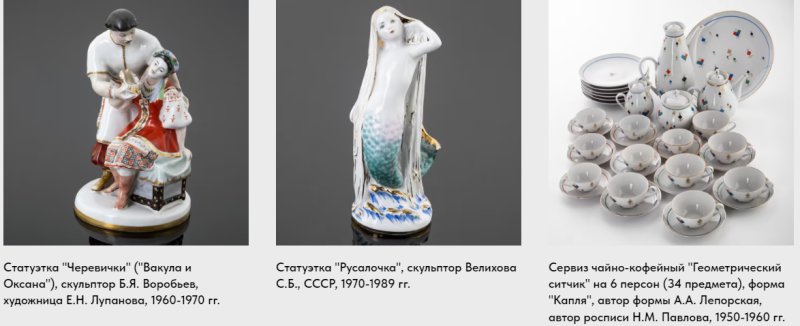
And in May 1969 the first batch of bone china was produced.
It was first used in the "May" form, created by Eduard Mikhailovich Krimmer (1900-1974). Throughout these decades new forms were constantly added to the range: "Apple", "Turnip", "Dandelion", "Classical", "Wave", "Sudarynya"...
The introduction of new technologies made it possible to expand the list of products manufactured and to organise mass production of bone thin-walled porcelain items, recognisable by their translucency, characteristic ring and thinness. For this development a group of factory specialists was awarded the USSR State Prize in science and technology. Young porcelain artists gained the opportunity to form an individual style and manner.
In 1975 the Leningrad Porcelain Factory fulfilled a government order: a service with hunting scenes for L. I. Brezhnev (the "Cylindrical" form by A. A. Leporskaya, painting by I. I. Riznich).
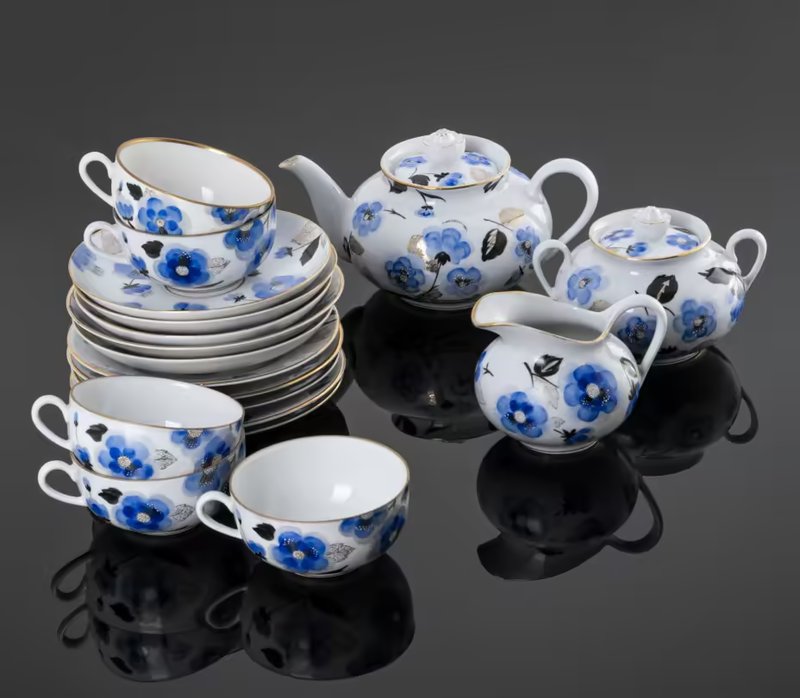
Tea service "Blue Double Flowers", "Turnip" form, 5 persons (18 items), form by Yakovleva S. E., painting by Bezpаlova-Mikhaleva T. N., 1950s-1960s. From the collection of the Odnajdy gallery.
From 1976 samples for the 1980 Olympics were made at the factory, and of the 37 items presented at the review, 35 received excellent marks.
P. P. Veselov created the famous talisman figurine of the 1980 Olympics, perhaps the only depiction of an animal in his work executed not in a realistic key. The bear, as sculpted by him, turned out very kind and cheerful, and the colouring was applied with an airbrush, which made it more delicate, with smooth transitions.
Olympic services were also issued in limited editions, coffee pairs depicting various sports (in the "May" form by E. M. Krimmer).
The factory also issued figurines for the World Festival of Youth and Students. Today they are among the rarest and most expensive.
Despite active work on state orders, in their free time the artists pursued their own creative research, and production samples went to the museum. Zonal, republican and all-union exhibitions were an integral part of the life of sculptors and artists.
Thus we can conclude that the creative range from the post-war years to the late 1980s was extraordinarily wide.
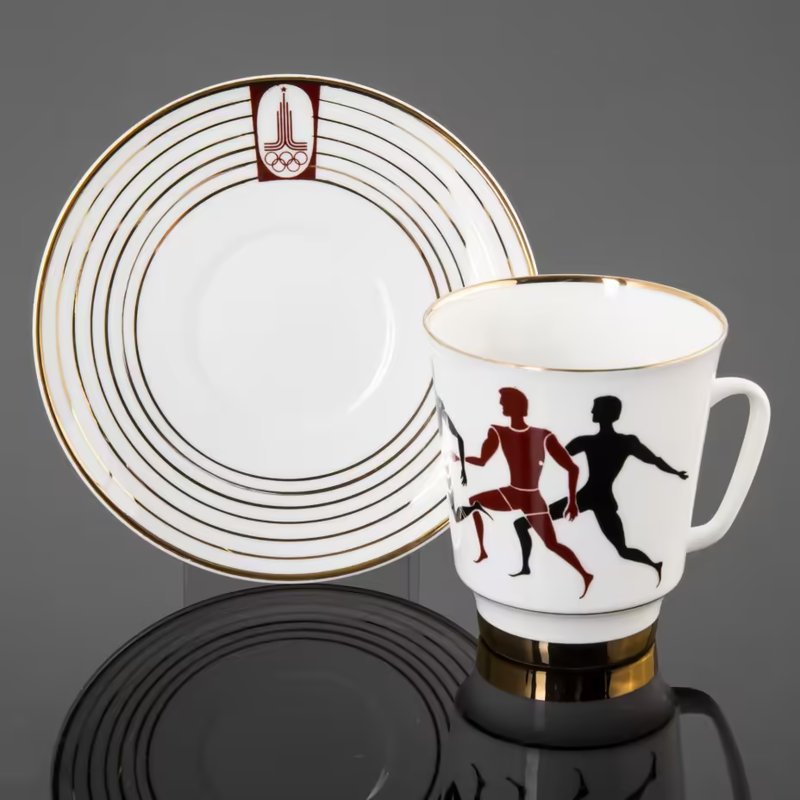
Coffee pair "Running. Olympics-80", form by E. M. Krimmer, 1980. From the collection of the Odnajdy gallery.
Original works of the Leningrad Porcelain Factory can be enjoyed in the museum located in St Petersburg at 151 Obukhovskoy Oborony Avenue. The factory museum was founded in 1844 by order of Nicholas I (for the centenary of the organisation of porcelain production) as a repository of samples worthy of study and copying. The museum's unique collection numbers more than 30,000 exhibits. Since 2001 the museum has been under the management of the State Hermitage. Works of the Leningrad Porcelain Factory are also held in many other museums of Russia and in private collections.
One of the most complete sources on the factory's history is the book by N. S. Petrova "Leningrad Porcelain Factory named after Lomonosov. 1944-2004"; the pieces are also presented in the catalogue "Soviet Porcelain 1917-1991. Illustrated Reference and Identification Guide" by I. Pelinsky and M. Safonova.
Today the Imperial Porcelain Factory continues to produce items from old models and also presents new original designs. But Soviet pieces are the most in demand among beginning and experienced collectors. As mentioned earlier, the most valuable from a cultural, historical and commercial point of view are the works of the 1920s-1940s, the propaganda porcelain, and the one-of-a-kind pieces no longer reproduced.
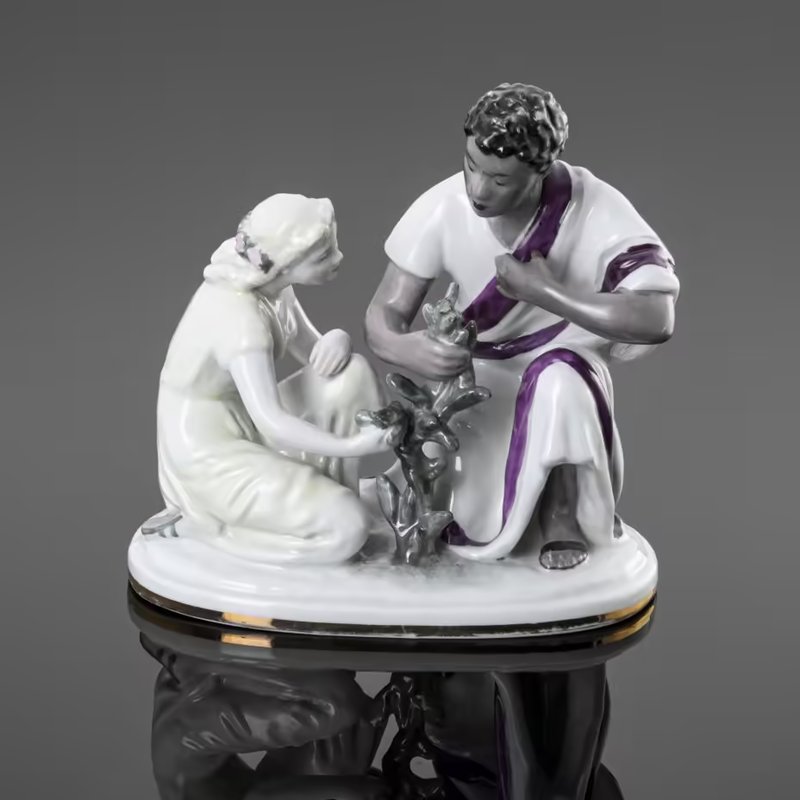
Figurine "Tree of Friendship", sculptor Nikonova I. N., 1950s-1960s. From the collection of the Odnajdy gallery.
When choosing Leningrad Porcelain Factory pieces it is very important to check them for defects (chips and cracks, which an inexperienced buyer may not always notice). It is advisable to examine cups for integrity and the absence of hidden cracks by the tapping method, so buying through private classified ads carries risks: both the dishonesty of the seller and poor packaging and careless transportation. A conscientious seller is also obliged to warn about any restorations, since professional restoration work may be invisible to the naked eye at the time of purchase.
Among services, figurines and other items there are both mass-produced and one-of-a-kind pieces, made in limited quantities for competitions, notable events and so on; accordingly, the latter cost much more. But, contrary to popular belief, it is not only expensive items that are skillfully faked. The modern antiques market is flooded with Chinese counterfeits with printed factory marks, ranging from the cheapest figurines to those worth hundreds of thousands of roubles.
The Odnajdy showroom presents a unique collection of porcelain pieces made by the Leningrad Porcelain Factory: figurines, services, inkwells, wall plates, decanters and much more. All items have undergone art-historical attribution and careful examination, so you can be sure that you are buying an authentic piece and will receive exhaustive information about it. You will find gifts both for the experienced and for the beginning collector, or you will treat yourself to a truly worthwhile acquisition. We also guarantee quality packaging and careful delivery.


